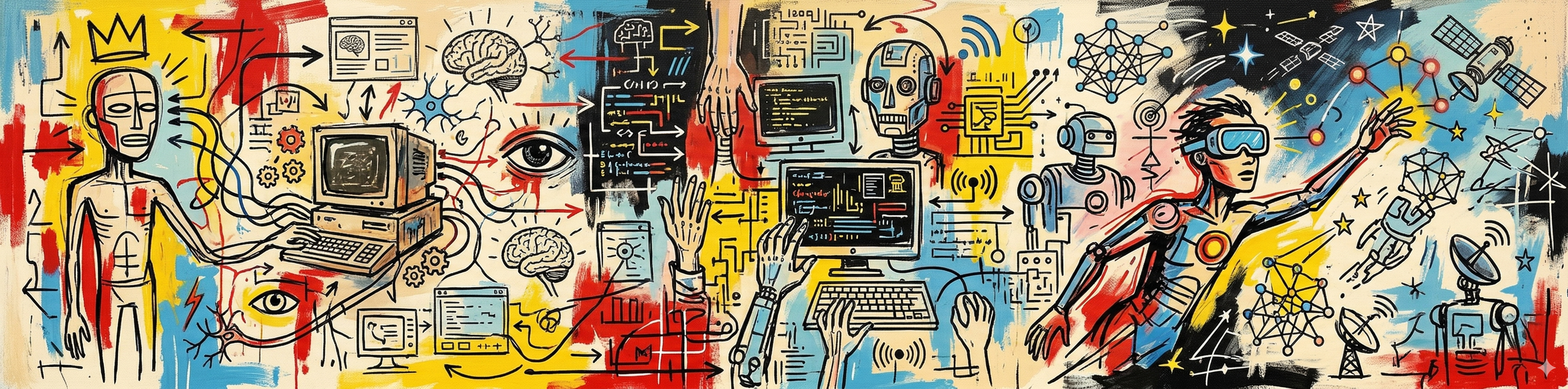
How will the future of human-computer interaction (HCI) evolve? Futuristic visions of HCI as conceptualized in popular media often depict a world filled with helpful AI collaborators, holographic displays, and voice- or gesture-based interactions. Whether these visions are filled with techno-optimism or dystopic-pessimism, they have been around for over 50 years? Is this where HCI is headed? If not, where?
This course equips students with the major animating theories of human-computer interaction, and connects those theories to modern innovations. We will examine foundational work in design theory, cognitive theory, ubiquitous computing, and human-centered AI. We will consider how these foundations have in turn led to research advances in virtual/augmented reality, automated design tools, accessibility and collaborative support. Unlike other courses in HCI this will primarily be focused on conceptual understanding rather than implementation and design practice.
Learning Goals: The goals of this course are to provide students with the foundations necessary for understanding and extending the current state of the art in human computer interaction. By the end of the course, students will have:
- An understanding of key HCI theories and methods, crossing domains such as ubicomp, human cognition, design theory, and human-centered AI.
- Experience critically discussing the core interaction design hypotheses described in HCI research texts.
Topics include ubiquitous computing, design tools+methods, AI+HCI, augmented and virtual reality, collaboration, accessibility…
We read about two papers per class. You will submit paper commentaries by 5:00 PM the evening before each class, to prepare for our discussion.
Once during the quarter, you will help us lead your section’s discussion on that lecture’s readings. Read all student commentaries before class, create a summary, and prepare a metacommentary on main themes.
For undergraduates or masters students in CS or SymSys, having taken CS147 or CS247 is a prerequisite. All graduate and PhD students from other departments are welcome. We expect attendance and active participation during lecture and discussion.
Teaching Staff
Instructor: Maneesh Agrawala
Office Hours: Thursdays 2-3pm, CoDa E362.
Course Assistant Jiaju Ma
Office Hours: Thursdays 4:30-5:30pm, CoDa 3rd floor common area near E362.
Course Assistant Jean-Peic Chou
Office Hours: Wednesdays 2-3pm, CoDa 3rd floor common area near E362.
Course Assistant Yujie Tao
Office Hours: Mondays 2-3pm, CoDa E320.
Questions?
Email us: cs347@cs.stanford.edu